
Understanding the Systems Lifecycle
Why good systems stop working, and when to act
Every growing business follows a predictable pattern. Your early systems work perfectly—until they don’t.
Understanding this lifecycle helps you recognize where you are and act at the right time.
Why growing businesses hit this wall
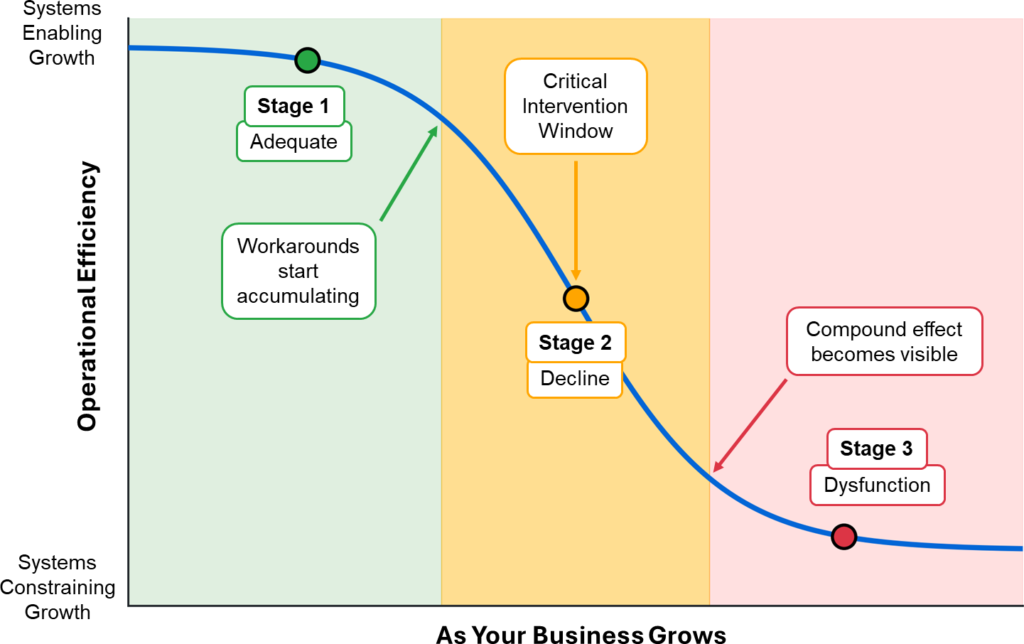
The three stages in detail
Adequate
- Free or inexpensive tools that are genuinely “good enough”
- Not purpose-built, but they actually work at this stage
- Focus on getting business running
- Minimal overhead, maximum flexibility
- Curve shows: Flat top – systems genuinely adequate, not declining yet
Decline
- Workarounds emerge so gradually that they don’t raise red flags
- Business leader too focused on operations to notice accumulating friction
- Tools stretched beyond original intent
- Processes built around tool limitations
- Each adaptation feels minor in the moment
- Curve shows: Steep middle section – systems declining rapidly
- Easiest to address before you’re stuck
Dysfunction
- Systems are clearly constraining growth
- Operations built around inadequate tools
- Overhaul seems daunting, but staying stuck has a daily cost
- Too busy managing operations to plan the escape
- Curve shows: Flat bottom – stuck in plateau until you intervene
- Most businesses recognize the need for help at this stage
Why This Pattern Happens
This isn’t about incompetence—it’s natural progression when you’re focused on building your business.
Stage 1 works because:
- Your team is small enough to coordinate informally
- Simple tools genuinely handle the volume
- You can work around limitations without much friction
Stage 2 happens because:
- Workarounds emerge so gradually that they don’t raise red flags
- You’re too focused on operations to notice accumulating friction
- Each adaptation feels minor in the moment
Stage 3 feels stuck because:
- Operations are built around inadequate tools
- Overhaul seems too daunting and disruptive
- You’re too busy managing growing operations to tackle it
Stage 2 – Prevention: Friction is emerging but you’re not stuck yet. This is the easiest time to intervene—systems are constraining growth, but operations haven’t been built around the workarounds yet.
Early Stage 3 – Planning: You’ve recognized the problem. Assessment helps you understand the scope and plan a methodical escape without disrupting operations.
Deep Stage 3 – Intervention: Operations are stuck in the plateau. This requires more effort than Stage 2, but the payoff is immediate—every day in dysfunction has a cost.
Wherever you are, we can help.
Each Stage Requires a Different Approach
When Do Most Businesses Act?
Reality: Most businesses don’t recognize they need help until Stage 3. That’s normal. The dysfunction becomes obvious before the gradual accumulation does.
Our Role:
- Stage 1 → Stage 2 (Prevention): Help you design systems that scale with you (prevents the plateau)
- Stage 2 (Intervention): Help you act before you’re stuck (easier than Stage 3)
- Stage 3 (Escape): Help you plan and execute the overhaul (higher ROI, more urgent)
We’re most valuable at Stage 3, most efficient at Stage 2, most strategic at Stage 1→2. All three are good times to engage.
Schedule a 30-minute assessment call to:
- Identify your current stage
- Understand what timeline makes sense
- Determine whether action or awareness is more valuable right now